Silo aeration pads
Air is introduced near the hopper or silo outlet to assist powder movement. Suitability depends on the powder behaviour, vessel geometry and the quality and distribution of the air supply.
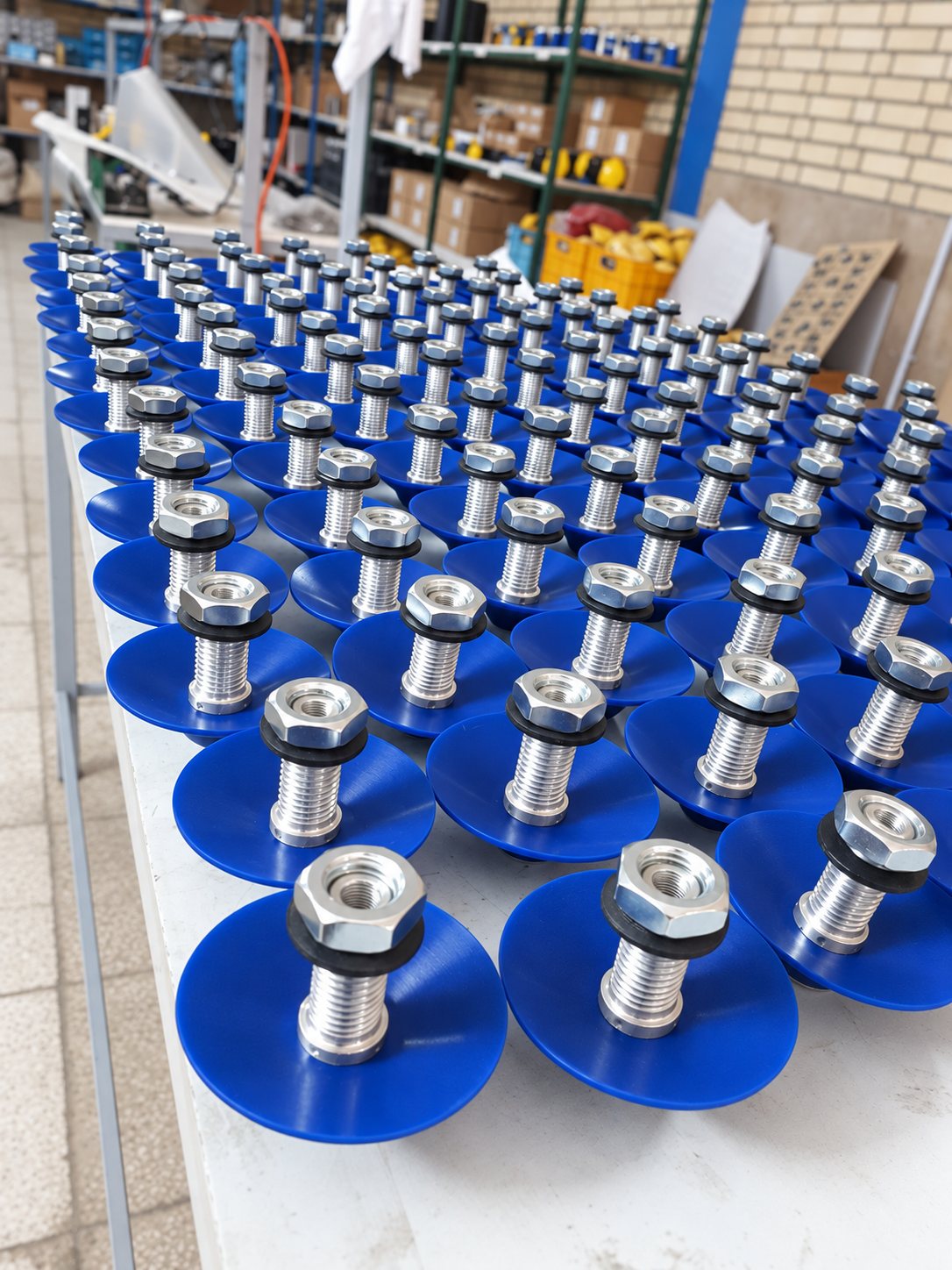
Aeration is a separate mechanism from vibration or impact. It must be reviewed for the material, especially where moisture, contamination, segregation or entrained air can affect the process. The air supply and the vessel venting arrangement are considered together.
Technical selection
| Powder | Particle size, bulk density, moisture sensitivity, flow behaviour and process cleanliness. |
|---|---|
| Location | Hopper angle, outlet, pad number and orientation, wall connection and access. |
| Air supply | Required pressure and flow, filtration, dryness and valve arrangement. |
| Operation | Continuous or pulsed air, operating sequence, venting and coordination with discharge. |
Air distribution and commissioning
- Identify the accumulation zone from the hopper drawing and discharge behaviour. Check wall angle, outlet dimensions and access to the connection.
- Select the number and distribution of pads together with the available air capacity. A fixed pad count cannot be applied to every silo.
- Install the connections and seals for the selected pad and wall arrangement; check the air line and control valve before discharge.
- Test with the actual powder. Set the air timing in coordination with material discharge and inspect the result at the outlet.
Connection dimensions, component materials, working pressure, air consumption and temperature range are specified for the proposed model. For food or other sensitive processes, include the requirements for air that contacts the product.
Choosing between aeration, impact and vibration
| Aeration pad | Introduces air into the powder near the wall or outlet. Selection considers powder behaviour, air distribution and vessel venting. |
|---|---|
| Pneumatic hammer | Applies separate local impacts through a suitable reinforced mounting point. View pneumatic hammers. |
| Pneumatic vibrator | Transmits repeated vibration through its mounting. The operating cycle and structural response are reviewed together. View pneumatic vibrators. |
Installation & maintenance
- Keep the air supply clean and suitable for contact with the material.
- Inspect pads, connections, air distribution and signs of plugging or wear.
- Adjust operation based on actual discharge behaviour rather than adding excess air.
Equipment photographs

Request a technical review
Send the application, operating conditions, dimensions and available drawings or photographs. State any information that is still unknown so the technical review can address it.