Wedge wire mining screens
Slotted screen panels for mineral classification, drainage and dewatering. Selection starts with the separation duty and feed characteristics, then matches the slot, working surface, frame and supports to the host screen.

Operating principle and configuration
Surface wires and supporting members form a rigid panel with continuous slots. Material smaller than an opening can pass through; retained material travels along the deck. Particle shape, near-size material, bed depth and feed distribution also affect separation, so the nominal slot alone does not define the cut quality.
Classification and dewatering have different targets. Classification separates size fractions; dewatering removes liquid while retaining the required solids. For wet service, solids recovery and discharged moisture must be considered together with slurry loading and drainage. A panel replacement must also suit the deck motion and fastening arrangement.
Main technical specifications for selection
| Process duty | Classification, drainage, dewatering or media recovery; required product fractions, solids recovery and moisture target. |
|---|---|
| Feed characteristics | Particle-size distribution, particle shape, bulk density, hardness and abrasiveness; clay, sticky material and oversize impact loads. |
| Feed and water loading | Normal and peak feed, slurry solids content, moisture and wash-water duty; how feed spreads across the deck. |
| Slot and working surface | Nominal opening and tolerance, wire profile, slot direction and usable area. Select against the material and separation target. |
| Panel and mounting | Overall and active dimensions, frame, clamps, bolt holes, edge details and deck drawing. |
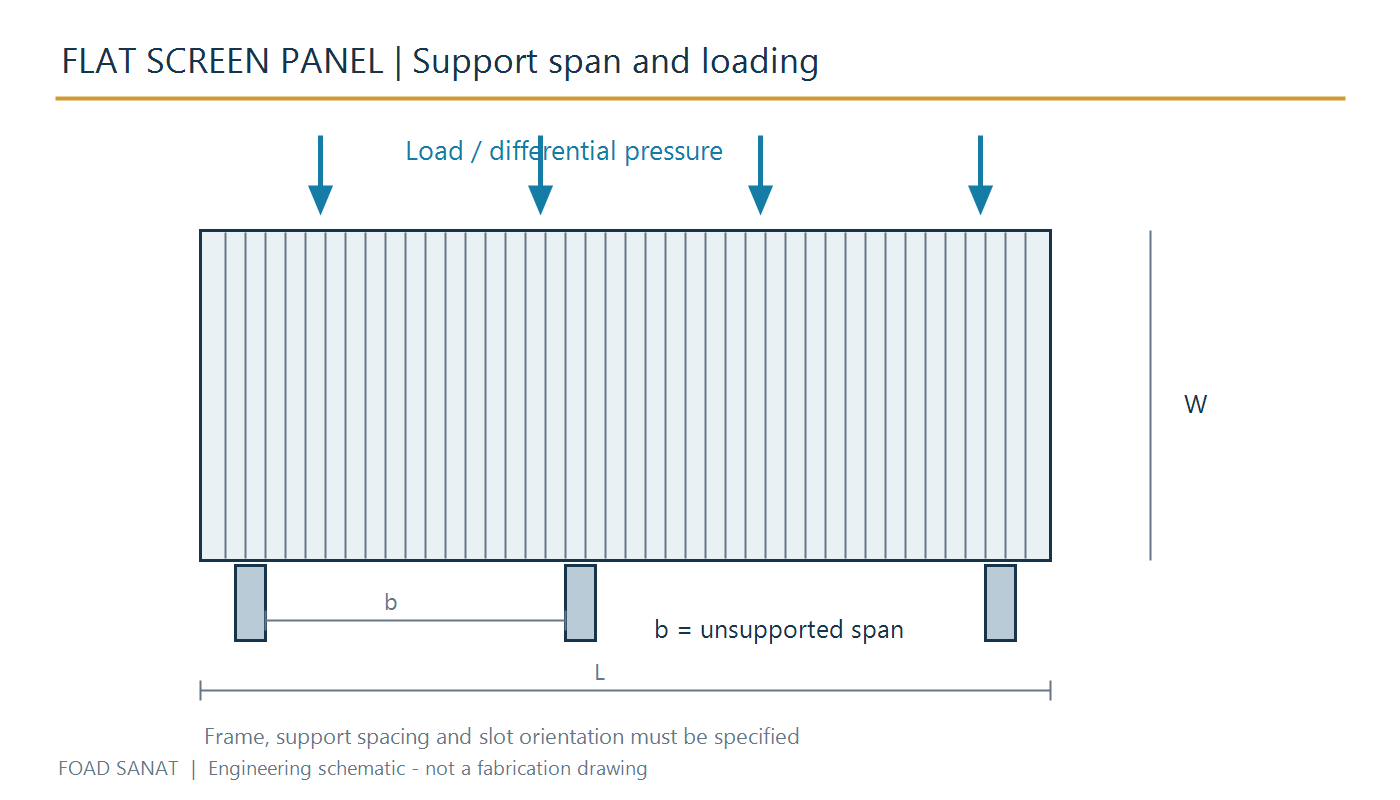
| Supports and movement | Support spacing, contact locations, deck inclination and host vibration conditions. Unsupported spans must match the specified duty. |
| Material and wear | Alloy compatibility with water chemistry and operating temperature; identify concentrated feed impact and existing wear patterns. |
| Inspection and supply scope | Panel only or framed assembly, number of sections, dimensional checks, slot inspection and agreed replacement criteria. |
Technical arrangement
Installation, inspection and cleaning
- Install panels on the specified supports and secure them using the host equipment’s fastening procedure. Check edges and joints for unintended bypass.
- Distribute feed across the working surface. Inspect the feed impact area and support contact points for local damage.
- Inspect for enlarged slots, cracked joints and blinding by near-size or sticky particles. Worn openings can change the product separation.
- Record throughput, product grading or moisture, wear location and cleaning history before changing the slot or panel arrangement.
Related filter equipment
Request a technical review
Send the process duty, feed grading, wet or dry loading, deck drawing, panel dimensions and photographs of the existing supports and wear. For a replacement, include the current slot and fastening details.