Wedge wire separator screen elements
Slotted components fitted inside separation equipment to pass one stream and retain the required solids. The pictured product is a separator drum; its shape, working face, slot and mounting must match the actual host machine.

Operating principle and configuration
A separator screen performs the separation duty defined by its host equipment. Liquid and particles able to pass the slots form one outlet; retained material forms the other. Both streams matter when assessing solids recovery, product quality and dewatering. Particle shape, fibres and deformable solids can affect passage through the surface.
The name separator does not define a single machine design. A stationary, rotating, vibrating or pressurized installation has different support and loading requirements. For the drum shown, flow direction, end connections, running clearances and cleaning contact must be established from the assembly drawing.
Main technical specifications for selection
| Separation duty | Material intended to pass and material to retain, required outlet quality, recovery or moisture target. |
|---|---|
| Host equipment | Machine type, model, part number, assembly drawing and the screen’s position in the process. |
| Feed properties | Particle grading and shape, flow, solids concentration, viscosity, temperature, adhesion and abrasion. |
| Screen geometry | Drum diameters and length or other defined shape, active area, ends, tolerances and any unslotted zones. |
| Slots and working face | Nominal opening, tolerance, wire direction, support orientation and direction through the surface. |
| Mounting and loading | Flanges, rings, frame, supports, seals and fixed or moving duty; include dynamic or pressure loading where applicable. |
| Material and cleaning | Fluid compatibility, screen and support materials, cleaning method and any scraper or adjacent-part clearances. |
| Replacement and inspection | Screen only or drum with fittings, quantities, dimensional and slot checks, and host-specific mechanical inspection. |
Technical arrangement
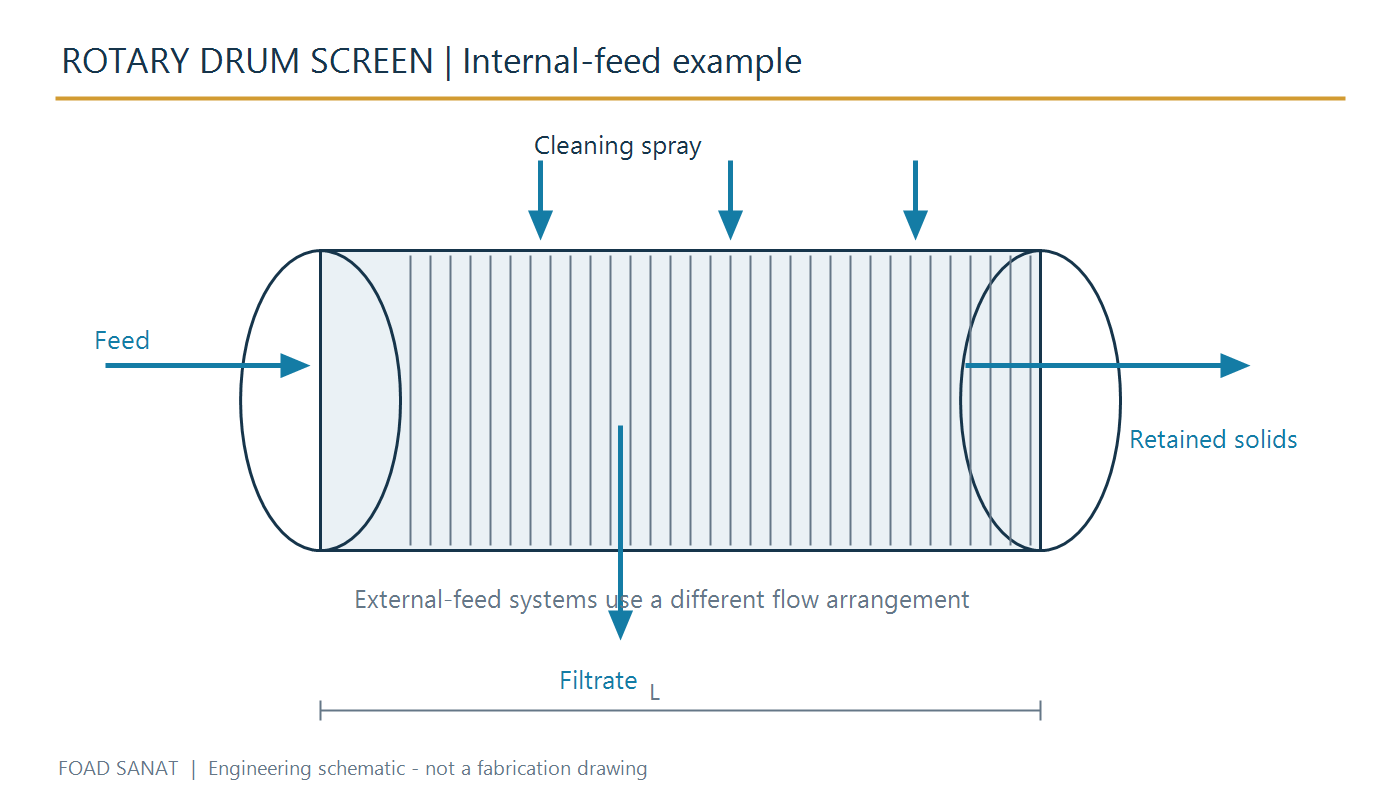
Installation, inspection and cleaning
- Check the assembly drawing and identify every mating surface before finalizing a replacement screen.
- Inspect both sides, ends and support joints. Record wear, cracking, deformation and plugging rather than relying only on the overall diameter.
- Compare both outlet streams when reviewing performance; clearer filtrate alone does not establish solids recovery or product moisture.
- Review changes to the slot, alloy or active area with the separation duty and available machine clearances before manufacture.
Related filter equipment
Request a technical review
Send a part and assembly drawing, photos of both faces and ends, host-machine information, current slot, feed properties and the required quality of both outlet streams. State whether rings, flanges or other mounting parts are included.