Wedge wire screens in water and wastewater treatment
Screening surfaces for incoming-solids separation, media retention and selected drainage or dewatering stages. Each stage has a different duty, so its opening, active area, support and cleaning arrangement are selected separately.

Process duties and selection approach
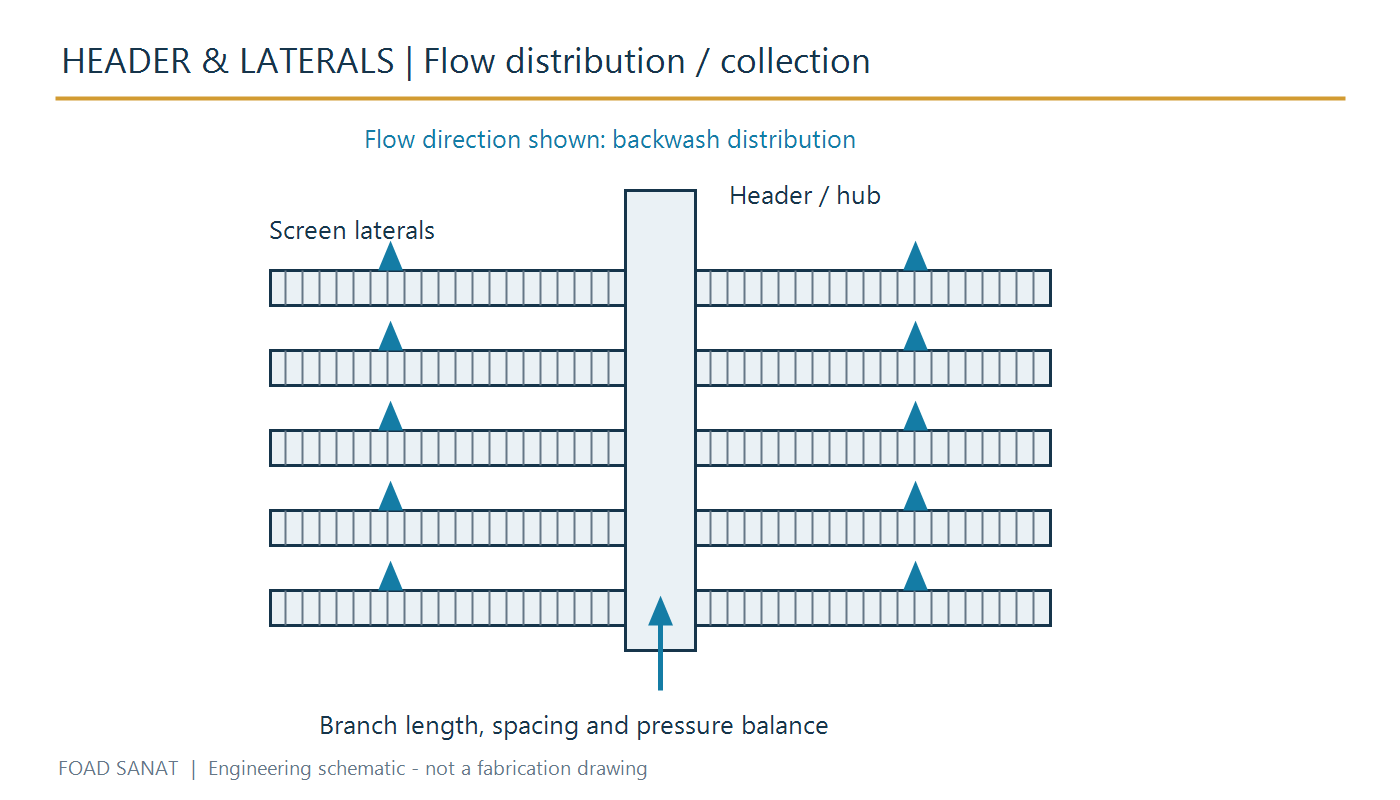
At an inlet, a panel, curved screen or drum separates specified solids before the next stage. In a media vessel, nozzles or header laterals retain bed particles and collect service flow or distribute cleaning water. Downstream dewatering has a separate target: solids recovery and the remaining liquid in the retained material.
The same nominal opening is not suitable for every treatment step. Peak flow, fibres, changing solids loading, buildup and cleaning access affect the usable surface. Wedge wire provides mechanical separation; dissolved substances, disinfection and biological treatment require their respective process stages.
Technical information for the application
| Process location | Intake screening, pretreatment, media retention, line protection or dewatering; define the inlet and both outlet streams. |
|---|---|
| Flow and hydraulics | Normal and peak flow, feed variation, available head or pressure drop and inlet/outlet levels. |
| Solids and media | Particle grading, fibres and deformable solids; for a bed, media grading, depth and support layers. |
| Water chemistry | Temperature, salinity, corrosive species, deposits and cleaning or disinfecting chemicals for material review. |
| Surface and openings | Screen form, nominal slot and tolerance, active area, direction of flow and support arrangement. |
| Service and backwash | Service and cleaning flow directions, permitted differential pressure, reverse flow and any specified air scour. |
| Installation and discharge | Vessel or equipment drawing, joints and seals, manway access, solids/reject route and removal space. |
| Supply and verification | Replacement surface or complete unit, material records, dimensional and slot checks, and the agreed process acceptance method. |
Technical arrangement
Equipment photographs


Installation, inspection and cleaning
- Check joints, seals and panel edges for paths that bypass the specified openings.
- Verify collection and cleaning directions before introducing media; follow the defined backwash and air-scour conditions where applicable.
- Inspect accumulated fibres, deposits, enlarged slots, corrosion and loose supports. Record how loading affects cleaning frequency.
- Keep reject and wash-water routes clear and confirm that cleaning removes contamination rather than simply moving it to another blocked location.
Relevant filter equipment
Request a technical review
Send the treatment stage, normal and peak flow, solids or media grading, water chemistry and temperature, allowable pressure drop, cleaning sequence and installation drawing. For replacement parts include dimensions and seal or connection details.