Wedge Wire Filter Applications by Industry

Wedge wire screens are selected around the process, not only the product name. Screen form, slot, support pitch, alloy and connection must match the fluid, solids loading, cleaning method and installation duty.

View wedge wire filter products
Wedge wire filter applications
Screen geometry and open area are matched to the actual process duty.

How the application changes the specification

Water treatment may prioritise media retention and backwash distribution; mining may require abrasion resistance and a reinforced frame; pulp and paper may need a self-cleaning surface and stable slot under fibre loading. For each project, state flow, solids, temperature, chemistry, target cut size and cleaning method before selecting the screen.

Industry applications

Water and wastewater

Use cylinders, nozzles, laterals and support grids for media retention, underdrain systems, intake protection and solid–liquid separation. Confirm media size distribution, service/backwash flow, vessel floor layout and allowable pressure drop.

Typical checks: slot tolerance, open area, corrosion allowance, sealing and cleanability.

Oil, gas and petrochemical

Screen elements and baskets protect pumps, separators and process equipment from solids. Specify the fluid chemistry, temperature, pressure, hazardous-area requirements, connection standard and differential pressure.

Typical checks: alloy compatibility, weld quality, support pitch and inspection access.

Power generation

Wedge wire components are used in cooling-water intake, condensate polishing, media vessels and debris separation. Review continuous duty, backwash frequency, water chemistry, vibration and the highest load case.

Typical checks: fatigue support, flange or threaded connection, cleaning sequence and replacement clearance.

Mining and mineral processing

Curved screens, panels, baskets and cylinders separate, drain and dewater mineral slurries. Abrasion, solids loading, feed distribution and access for flushing or replacement drive the design.

Typical checks: reinforced frame, wear allowance, support spacing and discharge arrangement.

Pulp and paper

Screen surfaces handle fibre, fines and process water in stock preparation, white-water recovery and filtration. Specify fibre loading, consistency, temperature, cleaning action and the required slot stability.

Typical checks: anti-blinding geometry, smooth welds, drainage direction and wash-water access.

Food and agriculture

Food and agricultural process screens are selected for cleanability, corrosion resistance and controlled separation of solids from liquid. Include hygiene constraints, product temperature, cleaning chemicals and product-contact alloy.

Typical checks: crevice-free construction, drainability, surface finish and removable mounting.

Common equipment forms

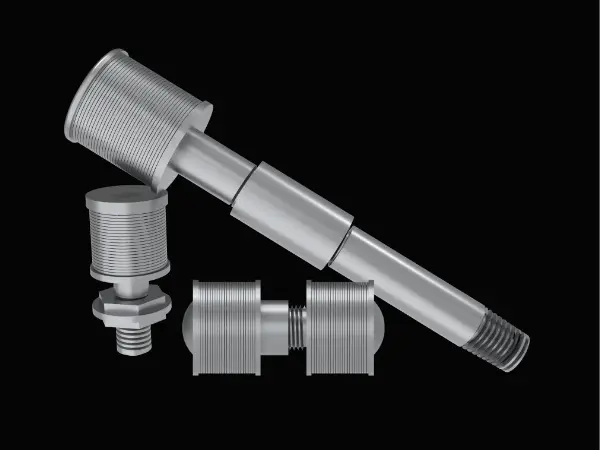
Cylindrical wedge wire screen
Cylinders: inline filtration, baskets and intake screens.
Flat wedge wire panel
Panels: drainage, separation and framed internals.
Wedge wire filter nozzle
Nozzles: media retention and distribution in vessels.

Information required for a technical review

InputWhat to provide
ProcessFluid, solids, flow rate, temperature, chemistry and target separation.
GeometryForm, diameter or panel size, active area, support points and installation clearance.
ScreenSlot width and tolerance, profile, support pitch, alloy and surface finish.
ConnectionsFlange, thread, clamp, weld, gasket and removal method.
MaintenanceBackwash, air scour, brushing, flushing, inspection and replacement requirements.

Request a project review

Send the process data, drawing or sample photos and the required connection. We will confirm the suitable screen form and the open technical items before fabrication.

Detailed industry application guides

Wedge wire screens in oil, gas and petrochemical processing

Slotted internals for media retention, process-flow collection and protection against escaped media or solids. The screen duty, fluid chemistry and mechanical loading define the specification for each installation.

Wedge wire screens in water and wastewater treatment

Screening surfaces for incoming-solids separation, media retention and selected drainage or dewatering stages. Each stage has a different duty, so its opening, active area, support and cleaning arrangement are selected separately.

Wedge wire screens in food and agricultural processing

Screens for incoming-water protection, washing-stream separation and product drainage or recovery. Irrigation-water service and direct food contact have different material, surface and cleaning requirements.

Wedge wire screens for mining and mineral processing

Screens for classification, slurry dewatering and liquid–solid separation. Feed grading, solids concentration, abrasion and the machine mounting determine the screen configuration.

Wedge wire filtration in power generation plants

Intake screening, cooling-water straining and media retention serve different points in a power plant’s water system. Specify the water source, downstream equipment and allowable flow restriction for each duty.

Wedge wire screens for pulp and paper processes

Screening for fibre recovery, process-water solids separation and dewatering. Fibre characteristics, feed consistency and the required quality of both outlet streams guide the selection.